# Data and memory lifecycle
Material is registered with its source, rights and purpose when it enters the platform; memory is kept apart by scope and is never a business ledger; reuse needs permission, and deletion is traceable to the end.
> Document ID: MYRILUM-DOC-ARCH-020
> Document type: concept
> Product: NOT_APPLICABLE
> Version: 0.1.0
> Region: GLOBAL
> Visibility: PUBLIC
> Publication: PUBLISHED_GLOBAL
> Content maturity: DRAFTED
> Governance: APPROVED
> Capability state: IN_DEVELOPMENT
> Availability: NOT_AVAILABLE
> Authorization: PUBLIC_INFORMATION
> Freshness: CURRENT
> Safety class: INFORMATIONAL
> Owner: Web3Capital Documentation Steward
> Approvers (assignment only; not approval evidence): Stephen
> Canonical authority: SRC-ARCHITECTURE-ATLAS-V2-2
> Source commit: 6b41cce4496de03c67a501aa94cd41ec6ac0e85a
> Content digest: 2978a885b5951f718e1a3184e83c4ab3be8de9fc3318ec11a7a2a69a860c43bf
> Effective: NOT_SET
> Expires: NOT_SET
> Last verified: 2026-09-23
> Review due: 2026-10-23
> Command authority: NONE
> Canonical URL: /en/architecture/data-and-memory-lifecycle
## What this map shows
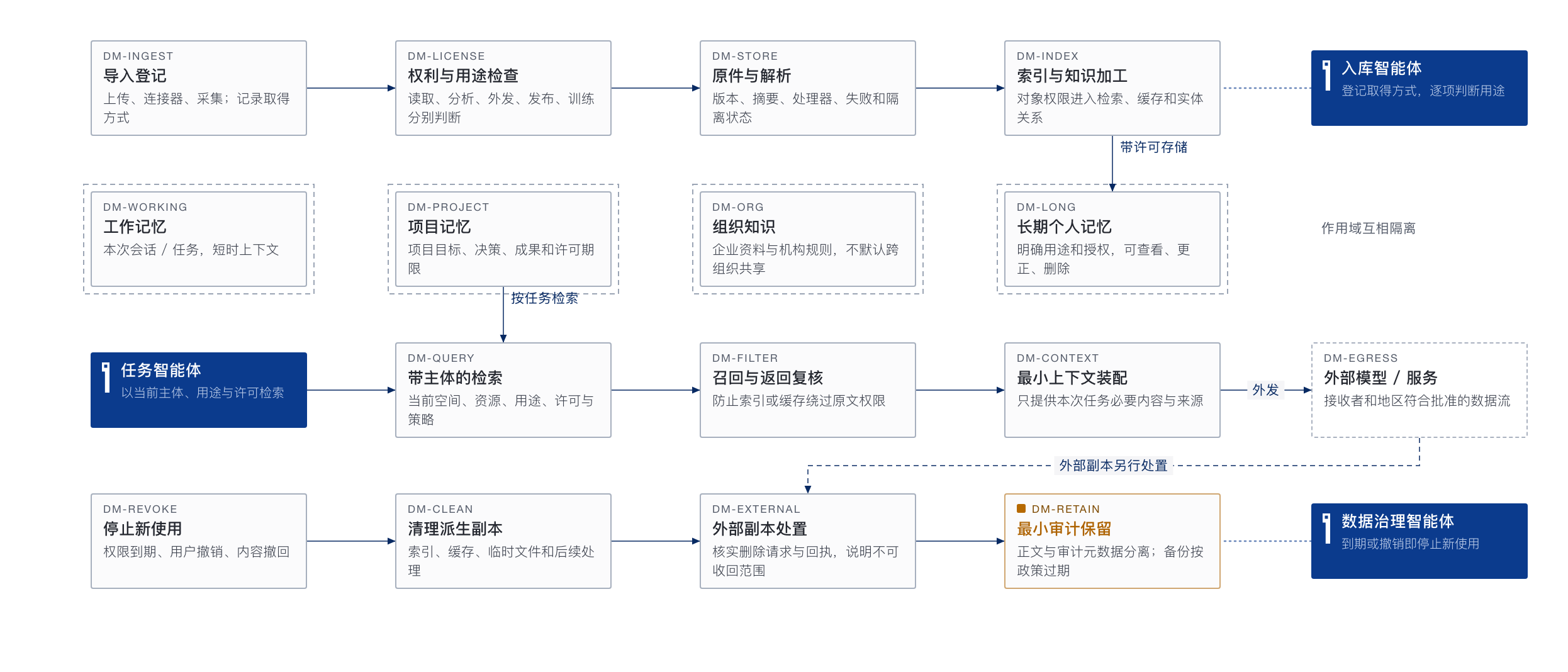
*MYRILUM architecture map v2.2 · A20 (public edition). Labels are in Chinese; every element is listed in English below. Select the diagram to open it at full size.*
This is MYRILUM's target architecture. It does not mean everything on the map is live; whether a capability can be used today is stated in “Current availability”.
Every piece of material carries its source, ownership, purpose, time, licence and deletion path.
Data entering the platform does not mean it may flow freely across the ecosystem; every reuse needs a scope and a purpose.
## Acquiring and processing data
| Field | Value |
|---|---|
| Intake registration | Uploads, connectors and collection; records how the material was obtained |
| Rights and purpose check | Reading, analysis, sending out, publishing and training are each judged separately |
| Originals and parsing | Versions, digests, processors, failures and quarantine status |
| Indexing and knowledge processing | Object permissions carry into search, caches and entity relationships |
> **Not one big knowledge base** — Personal, project, enterprise, public and platform-evaluation material each keep their own authorization boundary.
## Memory has different scopes
| Field | Value |
|---|---|
| Working memory | This session or task; short-lived context |
| Project memory | Project goals, decisions, results and licence periods |
| Organization knowledge | Enterprise material and institutional rules; not shared across organizations by default |
| Long-term personal memory | A stated purpose and authorization; can be viewed, corrected and deleted |
> **Memory is not a business ledger** — A model remembering “paid” can never create a payment fact; business state always goes back to the authoritative record.
## Reading, reuse and sending out
| Field | Value |
|---|---|
| Retrieval with a subject | The current space, resource, purpose, licence and policy |
| Re-checking what is recalled and returned | Stops an index or cache from bypassing the original's permissions |
| Minimal context assembly | Supplies only the content and sources this task needs |
| External models and services | Recipients and regions match the approved data flow |
> **Reuse needs permission** — Being able to read an earlier project's material does not mean a new project, another enterprise or a training process may use it.
## Revocation, deletion and retention
| Field | Value |
|---|---|
| Stopping new use | Permission expiry, user revocation or content withdrawal |
| Cleaning derived copies | Indexes, caches, temporary files and downstream processing |
| Handling external copies | Verifies deletion requests and receipts; states what cannot be recalled |
| Minimal audit retention | Content is kept apart from audit metadata; backups expire by policy |
> **Deletion is traceable too** — Request, execution, external confirmation and retention exceptions are recorded separately; sending a deletion request is never shown as done.
## Source
This page follows A20 of the MYRILUM architecture map v2.2 (public edition: restricted products and internal open items are left out). Related: “Data, knowledge, memory and evidence”; “Regions, disaster recovery and exit”.
---
This document is read-only, grants no command authority, and does not authorize deployment, payment, provider modification, or any other real-world action.